USPAP, UAD, and Lender Compliance: Why Appraisers Are Outsourcing Report Writing in 2026
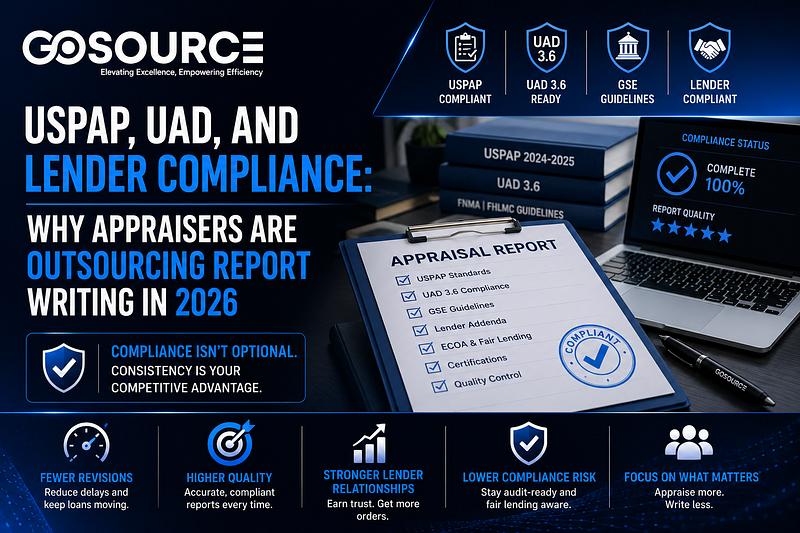
Compliance in appraisal report writing has never been more demanding. Between USPAP standards, UAD 3.6 field requirements, FNMA and FHLMC guidelines, ECOA obligations, and individual lender addenda. The documentation burden on appraisers and AMCs has grown substantially. A single oversight, an inconsistent market conditions adjustment, a missing certification, or a UAD field coded incorrectly can trigger a revision request, delay a loan closing, or raise flags during an audit.
In 2026, more appraisers and AMCs are responding to this reality by choosing to outsource appraisal report writing to compliance-trained professionals. This isn’t about cutting corners. It’s about ensuring that every report that leaves your office meets the exact standards lenders and GSEs expect consistently, at scale.
The Compliance Landscape Has Gotten More Complex
The appraisal compliance environment has seen significant changes over the past two years. UAD 3.6, the GSE-mandated update to the Uniform Appraisal Dataset, introduces new data fields, revised coding requirements, and more granular property conditions and quality ratings. Appraisers who learned UAD under the previous framework are navigating a learning curve that takes time away from core valuation work.
At the same time, USPAP continues to evolve. The 2024–2025 edition introduced clarifications around the scope of work, competency requirements, and record-keeping obligations that affect how reports must be written and supported. Staying current requires ongoing education and careful attention to how compliance language is woven into each report’s narrative.
Lender-specific requirements add another layer. A report acceptable to one lender may require additional addenda or alternate certification language for another. AMCs managing panels that serve multiple lenders must track these variations across every order, a significant operational challenge.
Where Compliance Failures Actually Happen
Most compliance failures in appraisal reports don’t come from bad appraisal judgment. They come from the report’s writing and documentation to stage the part that happens after the inspection.
Common compliance breakdowns include:
UAD field inconsistencies. A property quality or condition rating coded in one section that doesn’t align with the narrative description in another. These mismatches are caught by automated review tools and trigger immediate revision requests.
Missing or incomplete certifications. USPAP requires specific certification language in every report. Rushed report preparation leads to omissions that require correction before the report can be accepted.
Inadequate market conditions documentation. Supporting adjustments with sufficient market data is both a USPAP requirement and a common point of lender scrutiny. Reports that adjust without adequate narrative support face pushback during review.
Addenda errors. Lender-specific addenda that are improperly completed, outdated, or attached to the wrong report type create delays and reduce lender confidence.
Each of these failure points is a documentation problem, not an appraisal problem. And documentation problems are exactly what professional report writing teams are trained to prevent.
How Outsourcing Reduces Compliance Risk
When you outsource appraisal report writing to a team that specializes in this function, compliance becomes a built-in quality rather than an individual appraiser’s responsibility to manage under time pressure.
Dedicated compliance checklists. Professional report writing teams work from structured checklists aligned to current USPAP, UAD, and GSE requirements. Every report goes through the same verification process before delivery, regardless of order volume or time pressure.
UAD 3.6 expertise. A specialized report writing partner stays current with UAD updates as a core business requirement. Their writers understand the new field structures, revised conditions and quality scales, and data submission requirements that UAD 3.6 introduces.
Lender Addenda Management. Experienced outsourcing teams maintain current libraries of lender-specific addenda and know which forms apply to which report types and lender requirements. This eliminates the risk of submitting outdated or incorrect supplemental documentation.
Consistent language and formatting. USPAP compliance isn’t just about what’s in the report; certifications ensure every report meets the same baseline standard.
The ECOA and Fair Lending Dimension
Compliance in mortgage-adjacent services now extends beyond USPAP and UAD. The Equal Credit Opportunity Act (ECOA) and fair lending regulations have increased scrutiny on how property characteristics are described and how adjustments are supported in appraisal reports.
Regulators and advocacy groups have highlighted concerns about language in appraisal narratives that could be construed as referencing protected class characteristics directly or indirectly. Professional report writing teams trained in fair lending awareness to help ensure that report language stays on the right side of these requirements.
For AMCs working with lenders who have active fair lending compliance programs, this is an increasingly important dimension of report quality. Outsourcing a team with fair lending awareness built into its writing standards is a meaningful risk management step.
What Consistent Compliance Does for Your Business
Beyond avoiding revision requests and audit flags, consistent compliance has direct business value for appraisers and AMCs.
Lenders maintain preferred vendor lists and route orders toward AMCs with strong compliance track records. Consistently clean reports, no UAD errors, no missing certifications, and no addenda issues build the kind of reputation that translates directly into order volume.
For individual appraisers, compliance consistency protects licensure. State appraisal boards review complaint files that often originate from reported deficiencies. Reducing documentation errors is a direct form of professional risk management.
For AMCs, clean reports reduce the staff time spent managing revision cycles, responding to lender inquiries, and tracking missing documentation. That time has real dollar value — and recapturing it improves margins on every order.
Making the Transition to Outsourced Report Writing
Transitioning to an outsourced report writing model doesn’t require an operational overhaul. Most appraisers and AMCs start by outsourcing a subset of their volume, typically standard 1004 and 1073 reports, while retaining internal handling for complex or non-standard assignments.
As confidence in the outsourcing partner builds, volume can expand. The key is selecting a partner with demonstrated USPAP and UAD expertise, clear SLAs, and a transparent quality review process.
Frequently Asked Questions
Q1: What is UAD 3.6, and why does it matter for report writing compliance? UAD 3.6 is the updated Uniform Appraisal Dataset mandated by Fannie Mae and Freddie Mac. It introduces new data fields, revised property conditions, quality ratings, and more structured reporting requirements. Reports that don’t conform to UAD 3.6 standards will be rejected by GSE for automated review systems, making compliance expertise in report writing critical.
Q2: Can a non-licensed person legally assist with appraisal report writing? Yes, under USPAP Standards Rule 2–1 and related guidance, appraisers may use the assistance of others in preparing their reports. The key requirement is that the licensed appraiser discloses any significant assistance received and takes full responsibility for the report’s content, analysis, and conclusions.
Q3: What USPAP certifications must appear in every appraisal report? USPAP requires a signed certification that addresses the appraiser’s independence, absence of bias, personal inspection status, prior services disclosure, compensation disclosure, and compliance with USPAP standards. Missing or incomplete certification of language is one of the most common causes of lender revision requests.
Q4: How does ECOA affect appraisal report language? ECOA and related fair lending guidance require that appraisal reports avoid language that references or implies consideration of protected class characteristics, including race, national origin, religion, sex, familial status, and disability. Professionally trained report writers apply fair lending-aware language standards to every narrative they produce.
Q5: How do outsourcing partners stay current with changing lender addenda requirements? Established outsourcing partners maintain continuously updated addenda libraries organized by lender and report type. They track GSE guideline updates and lender bulletins as part of their standard operations, a function that would require dedicated staff time to replicate in-house.
Q6: What happens if an outsourced report has a compliance error? Reputable outsourcing partners stand behind their work. Their service agreements include revision policies that cover compliance-related corrections at no additional charge. When evaluating partners, always confirm the revision policy in writing before committing volume.
Conclusion
Compliance pressure in appraisal report writing is only going to increase as UAD 3.6 rolls out fully; GSE oversight intensifies, and fair lending scrutiny extends further into the valuation process. Appraisers and AMCs that try to manage this complexity entirely in-house under time pressure, with inconsistent processes, are taking unnecessary risks.
Outsourcing report writing to compliance-trained professionals is a structural solution to a structural problem. It brings consistency, expertise, and scalability to the part of the appraisal process that carries the most compliance exposure.
Want to stay ahead of compliance changes in 2026? Visit the GoSource Valuation blog for expert resources on USPAP, UAD 3.6, and AMC operations and learn how outsourced appraisal report writing can protect your business from costly compliance gaps.